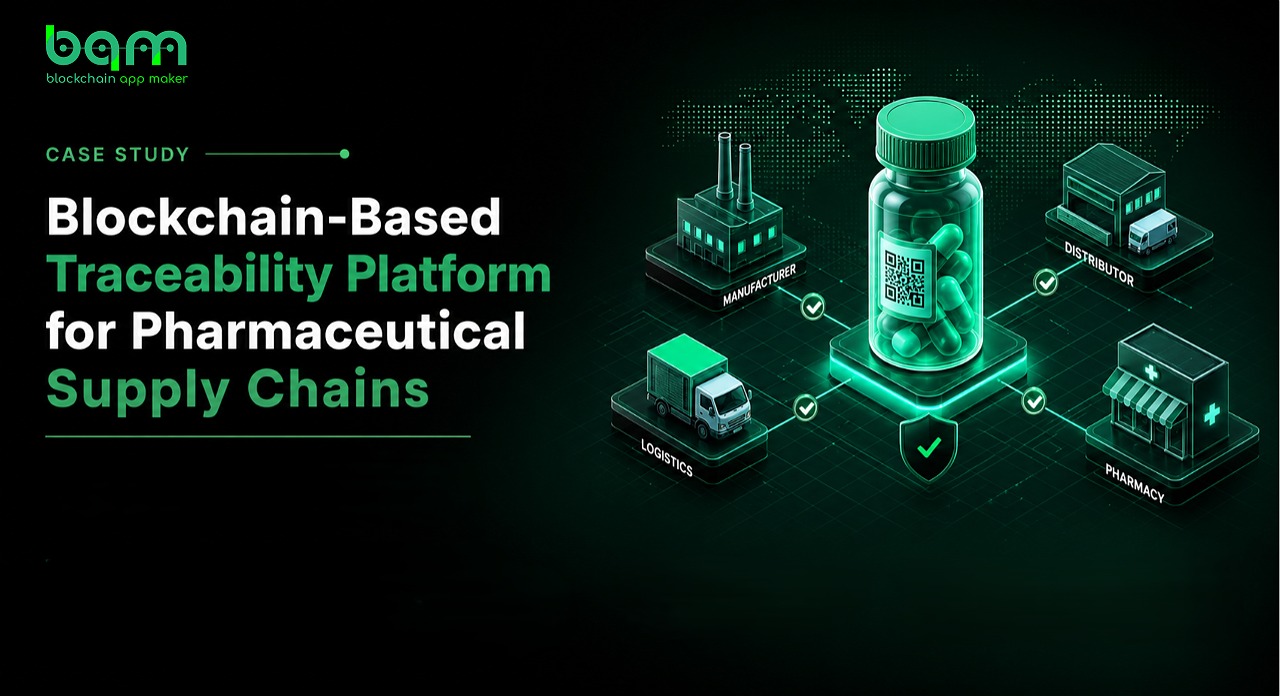
A Permissioned Blockchain Network for End-to-End Pharma Traceability
Helping a U.S. pharmaceutical distributor improve product traceability, accelerate recalls, and strengthen DSCSA compliance with a Hyperledger Fabric consortium network.
Client details have been anonymized for confidentiality. The business outcomes presented are based on a representative enterprise implementation.
The Challenge
A mid-sized pharmaceutical distribution company operating across more than 40 U.S. distribution centers struggled with fragmented supply chain data, lengthy recall investigations, and increasing regulatory pressure under the Drug Supply Chain Security Act (DSCSA). Product information was spread across multiple ERP systems, paper records, and third-party logistics platforms, making it difficult to establish a reliable chain of custody.
The Solution
Blockchain App Maker designed and implemented a permissioned Hyperledger Fabric network that unified manufacturers, distributors, logistics providers, and pharmacies on a shared, tamper-resistant ledger. The platform integrated serialization verification, IoT-enabled cold-chain monitoring, and automated compliance workflows without requiring trading partners to replace their existing ERP systems.
From fragmented paperwork to a single, tamper‑evident ledger
A mid-sized pharmaceutical distributor operating more than 40 U.S. distribution centers moved from manual, batch-level tracking to real-time, unit-level traceability.
Project at a glance
No single trusted source of truth
Manufacturers, 3PLs, wholesalers, and pharmacies each ran independent systems with limited interoperability. The client's supply chain involved manufacturers, third-party logistics providers (3PLs), wholesalers, and pharmacies, each operating independent systems with limited interoperability. While every participant maintained its own records, there was no single trusted source of truth across the entire supply chain. This created several critical business challenges:
- ✕Product traceability depended on manual reconciliation across multiple systems.
- ✕Recall investigations often took days because affected products had to be traced manually.
- ✕Compliance with DSCSA interoperability requirements became increasingly difficult.
- ✕Counterfeit or diverted medicines could move through several supply chain stages before discrepancies were identified.
- ✕Cold-chain monitoring relied on disconnected systems with limited visibility.
What the client set out to achieve
End-to-End Traceability
Build product traceability from manufacturer to pharmacy.
Faster Recalls
Reduce recall response time from days to hours.
Shared Visibility
Improve visibility across all trading partners.
Automated Compliance
Automate DSCSA compliance reporting.
Counterfeit Detection
Detect counterfeit products before they enter downstream distribution.
Non-Disruptive Integration
Integrate blockchain with existing ERP and warehouse systems without disrupting operations.
Why blockchain instead of a traditional database?
For a single organization, a conventional database would be enough. This project involved independent organizations that needed to exchange trusted information without any one participant owning the master database. One of the first questions during discovery was whether blockchain was actually necessary. However, this project involved multiple independent organizations—including manufacturers, distributors, logistics providers, and pharmacies—that needed to exchange trusted information without allowing any single participant to own or control the master database.
Shared Trust
Every participant maintains a synchronized copy of approved transaction records, removing dependence on a single centralized authority.
Tamper-Evident Records
Every custody transfer is cryptographically recorded, providing an immutable audit trail for regulatory compliance.
Controlled Data Sharing
Hyperledger Fabric lets organizations share only what's needed for a transaction while keeping sensitive business data private.
How the network connects every stakeholder
Blockchain became the trusted coordination layer connecting existing enterprise systems, rather than replacing them. Instead of replacing existing enterprise software, the solution integrates with current ERP and WMS platforms through middleware, allowing organizations to adopt blockchain without disrupting day-to-day operations.
- Serialization Verification
- Custody Transfer Validation
- DSCSA Compliance Checks
- Temperature Monitoring
Built for privacy, scale, and compliance
To meet the client's privacy, scalability, and compliance requirements, Blockchain App Maker selected a technology stack designed specifically for enterprise pharmaceutical supply chains. Hyperledger Fabric was chosen because it enables permissioned access, granular data privacy, and high transaction throughput—making it significantly better suited for enterprise collaboration than public blockchain networks for this use case.
| Component | Technology |
|---|---|
| Blockchain Platform | Hyperledger Fabric |
| Smart Contracts | Fabric Chaincode (Go) |
| Data Exchange Standard | EPCIS 2.0 JSON-LD |
| ERP Integration | SAP-Compatible Middleware |
| IoT Integration | Temperature & Humidity Sensors |
| Off-Chain Storage | Secure Document Repository with On-Chain Hash Verification |
Key outcomes after deployment
Following deployment, the client achieved measurable improvements across operational efficiency, compliance, and supply chain visibility. Beyond these measurable improvements, the organization gained a trusted, shared source of truth across manufacturers, logistics providers, distributors, and pharmacies—strengthening collaboration while reducing operational risk.
Recall response time reduced from approximately 72 hours to 8 hours, enabling faster identification and isolation of affected products.
Manual verification workload decreased by nearly 85% through automated serialization and custody validation.
End-to-end unit-level traceability replaced fragmented batch-level tracking across the distribution network.
Real-time counterfeit detection enabled immediate identification of suspicious products during custody transfers instead of after downstream investigations.
Automated compliance reporting eliminated spreadsheet-driven processes and simplified DSCSA audit preparation.
Lessons from the project
This implementation demonstrates that blockchain delivers the greatest value when multiple independent organizations need to exchange trusted information without relying on a single central authority. Starting with a focused implementation allows organizations to validate business value before scaling across larger distribution networks.
Secure, Selective Collaboration
Permissioned blockchain provides secure collaboration while protecting sensitive business information.
Lower Implementation Complexity
Integrating blockchain with existing ERP and WMS platforms significantly reduces implementation complexity.
Efficiency Through Automation
Automated smart contracts improve operational efficiency by replacing repetitive manual verification.
Stronger Compliance
Real-time traceability strengthens regulatory compliance and reduces counterfeit risk across the pharmaceutical supply chain.
Built for every link in the pharma supply chain
Explore more of what we build
- Enterprise Blockchain Development
- Blockchain Consulting Services
- Smart Contract Development
- Hyperledger Blockchain Development
- Healthcare Blockchain Development
- Supply Chain Blockchain Solutions
- Asset Tokenization Development
- Web3 Development Services
- AI Development for Intelligent Supply Chain Automation
Ready to Build a Transparent Pharmaceutical Supply Chain?
Modern pharma supply chains need more than visibility — they need trust, compliance, and real-time collaboration across every stakeholder. Talk to our blockchain specialists and discover how enterprise blockchain can transform your supply chain.